Biodiversity credit markets have emerged as a leading potential nature finance mechanism and, along with biodiversity offsetting, are considered one of the largest sources of private investment into nature. Credit markets inherit many of the technical challenges that are well characterised for biodiversity offsetting, including those how to objectively measure and defend a demonstrable net positive outcome in biodiversity. Another aspect of interest to many biodiversity credit markets is linking credits to wildlife species outcomes, in addition to habitat or ecosystem service outcomes (the latter being the focus of biodiversity offsetting, and other nature finance mechanisms).
In this pilot, we explore the potential for earth observation (EO) approaches to facilitate greater confidence in credit markets from the perspective of public, private, non-profit and academic stakeholders. This is not simply a matter of pairing biodiversity metrics with remote monitoring, reporting and verification (MRV); it is also about ensuring that gains at nature credit sites are a) shown to be due to these specific interventions and b) likely to endure over time – both of which are key investment requirements for nature credits. Furthermore, we explore whether there is scope for EO-based approaches to support species-based credits systems, despite known and inherent challenges with doing so from an EO perspective (e.g. EO data do not typically capture species directly).
Our focal case study is an emerging potential credit system linked to species credits, implemented within production landscapes in the Netherlands, which provides an excellent case study through which transferable credit-monitoring pipelines could be developed. We intend to demonstrate the onward transferability of this approach to other systems in which quantifiable biodiversity uplift is sought at landscape scales: either for the Makira project in Madagascar (one of Madagascar’s largest and most significant forest conservation and climate-finance initiatives, protecting the Makira Rainforest), or Southern Cone grasslands conservation in Argentina.
Pilot definition and requirements
Demand for biodiversity credits can emerge as a result of a range of drivers, including those which are both voluntary and mandatory (e.g. directly linked to biodiversity offsetting). In this pilot, we will explore the degree to which EO approaches can be better used to support emerging global nature markets based on biodiversity credits, particularly those focused on voluntary crediting schemes. There is a range of biodiversity metrics proposed by emerging biodiversity credit standards (see Wunder et al., 2025), and we will explore the subset of these for which EO approaches are directly or potentially relevant.
Key to this biodiversity credits pilot is the conceptual understanding that biodiversity credits can be generated through two main project types, with different EO challenges for each:
Large individual conservation projects generating considerable numbers of biodiversity credits, linked to major development projects (e.g. nationally significant infrastructure, such as involving mines or highways)
Here, credits will be generated at scale, and will likely include a mix of biodiversity uplift and ‘avoided loss’ credit types. Of interest will be to explore the degree to which refined landscape features or classes (corresponding to specific target species or group of species, and structural and functional indicators) can be detected through novel modelling approaches involving medium to high-resolution remote sensing imagery and in-situ observations (see Picard et al. 2024).
Landscape-scale biodiversity credit markets, in which multiple uncoordinated small-scale conservation projects are implemented to generate biodiversity credits (e.g. unconnected housing developments - see Bull & Strange, 2018).
Here, it may be that frequent monitoring and tracking of land at higher spatial resolution is required. Such credit markets may require widespread detection of marginal uplifts in ecological condition, e.g. on former farmlands; likely focused on the ecological condition and area for specific habitat types. Of interest in this example will be to explore how effectively taxonomic or functional indices for these landscapes can be derived by combining remotely-sensed data with in-situ observations, which would enable a robust characterisation of ecosystem condition.
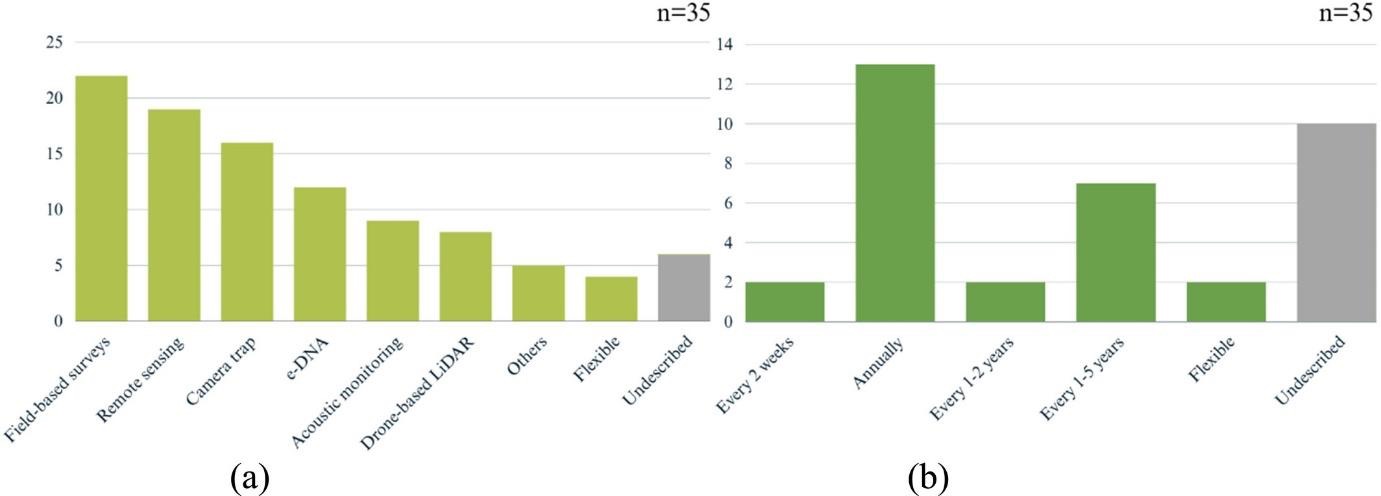
Figure 1: methodological approaches to monitoring (light green), and monitoring frequency (dark green) for existing biodiversity credit systems (Wunder et al., 2025)
In both types of project, a key question will be the degree to which sites generating credits are additional against reasonable counterfactuals. This requires, amongst other things, historical biodiversity trends (showing changes over time) in the credit sites and wider landscapes, in order to enable observational impact evaluation (see Guizar-Coutiño et al. 2026). Similarly, we will explore how pre-project projections of biodiversity impacts resulting from the project, can be better produced from EO-derived metrics at scale. Furthermore, EO could provide the means for monitoring leakage (of biodiversity impacts outside the project region due to the credit implementation), or to detect any initial signs of non-compliance to the credit rules, and thus provide a form of early warning system to investors.
A central objective is to identify the most appropriate EO applications to support the biodiversity metrics monitoring above, particularly those used in operational nature credit schemes. As can be seen in the figure below, existing credit initiatives rely upon a range of metrics, some of which can be fully or partially monitored thorough EO approaches.
Figure 2: biodiversity metrics specified in existing biodiversity credit systems (Wunder et al., 2025)
The first steps in our pilot are to map both (a) the data and metric requirements of the case studies and (b) the requirements under all key biodiversity credit mechanisms (see Wunder et al., 2025) more widely against current and potential EO capabilities. Based on known credit mechanisms and the results of the user surveys, this will likely result in a focus on using EO to track characteristics of habitats and ecosystem functions across a range of spatial and temporal scales; however, there will also be an interesting yet challenging component of considering the role of EO in credit mechanisms linked to wildlife species.
With respect to the two types of projects mentioned above: we will focus under work package 2 of LEON upon tracking biodiversity uplift for landscape-scale projects (e.g. habitat intactness and complexity for one early adopter organisation and investment in credit systems for another) and smaller scale projects (e.g. grassland floral diversity uplift across multiple farms). In some cases the focus will be on near-real time tracking of integrity and early warning of habitat degradation and/or loss, in others, on long term and low frequency (e.g. annual) gains in biodiversity from restoration measures. Then, we will explore the transferability of this workflow to a large individual project as part of work package 3.
Related standards and frameworks
In the context of the LEON project, biodiversity credits are viewed in relation to voluntary credit markets, and as distinct from e.g. regulatory/mandatory biodiversity offsets – the distinction being that regulatory/mandatory offsets compensate for specific negative impacts on biodiversity, while credits measure an uplift in biodiversity that is not necessarily designed to compensate for a specific loss elsewhere. Consequently, we do not include here the standards and frameworks that would be relevant to biodiversity offsetting specifically, of which there are a wide variety. Biodiversity credits are provided within the wider framework of the Kunming-Montreal Global Biodiversity Framework, under Target 19 (“Mobilize $200 Billion per Year for Biodiversity From all Sources, Including $30 Billion Through International Finance”) which includes the component “Stimulating innovative schemes such as... biodiversity credits”.
Key organisations involved in efforts to standardise concepts around biodiversity credits include the Biodiversity Credits Alliance (BCA, https://www.biodiversitycreditalliance.org/), the International Advisory Panel on Biodiversity Credits (IAPB; https://www.iapbiocredits.org/), and the World Economic Forum (WEF; https://www.weforum.org/). These organisations have interacted to publish guidance on credit markets; for instance, the “High Level Principles to Guide the Biodiversity Credit Market” from the BCA (2024), the “Framework for High Integrity Biodiversity Credit Markets” from the IAPB (2024), and the outputs from the WEF’s “Nature Markets and Biodiversity Credits Initiative”.
None of the above can yet be considered universally applied, although all are part of a build towards a consensus on credit frameworks. Meanwhile, a large number of biodiversity credit providers and/or standard-setters have emerged in recent years; recent reviews of these include those by Wunder et al. 2025; (see Figure 3 below), and the global biodiversity credits database maintained by Bloom Labs (https://www.bloomlabs.earth/).
Figure 3: Global map of biodiversity credit initiatives: operational state and market function (n=37) (from Wunder et al., 2025)
User requirements
Nine organisational survey respondents answered the questions related to biodiversity credits. Many respondents in this section were not yet actively involved in biodiversity credits – which is not surprising, given the nascent state of many of these markets – but they were interested in activities in this area in the future (6/9 respondents). Respondents’ primary drivers for involvement in biodiversity credits were financial return or investment opportunity (6/9 respondents) and environmental impact and conservation (5/9). In contrast, regulatory compliance, reputational benefits and risk management were both selected as a priority by 2/9 respondents . Furthermore, habitats were especially considered a focus by different respondents (see chart in Appendix C); this tallies with the findings for emerging credit systems in Wunder et al. (2025).
Over the first six months of the LEON project, the pilot team held unilateral interactions with the early adopter organisations and, at that time, understood the following in terms of user requirements:
FrieslandCampina, Rabobank. The two organisations work together on investment in nature across the Netherlands, and an emerging initiative will potentially revolve around biodiversity credits opportunities on Dutch farms. In this case, investors would pay into a credits scheme that was built on nature restoration actions implemented by farmers on their land, so increasing biodiversity and ecosystem services provision. This would be a national scheme, and require monitoring capability for potentially a large number of smaller sites, with marginal uplift in biodiversity on productive land, representing an interesting challenge for EO approaches to support.
Nature Solutions (Rio Tinto). The Nature Solutions team at Rio Tinto are exploring the upscaling of major landscape-scale conservation initiatives as part of corporate net positive policy, which may eventually be relevant to credit markets. The specific focus so far has been on such conservation projects in Madagascar and mainland East Africa. Working with existing partners (e.g. WCS) and LEON, Rio Tinto is keen to improve the monitoring of biodiversity outcomes on such initiatives using a combination of EO and in-situ datasets.
Finance Denmark. Finance Denmark represents a large number of member organisations, and an interest in the opportunities presented by emerging nature credit markets, if members were to increase their investment in these markets. However, there would need to be full confidence in the integrity of those credit markets; especially given recent concerns raised around carbon credits/REDD+ (generating more credits than reduction in emissions). Therefore, Finance Denmark has engaged with LEON to explore how EO approaches might be leveraged to provide greater confidence in credit markets and, in turn, enable further investment.
Asian Development Bank. The newly developed ADB lending safeguards require net gains in biodiversity for projects to which the Bank lends. The Bank is keen to explore how EO approaches can be better utilised to confirm biodiversity uplifts in relation to a range of projects that they lend to across Asia, as well as potentially providing an early warning system for cases in which established biodiversity initiatives are threatened.
The five organisations identified above come to this project seeking applications to measure and monitor biodiversity for different ecosystems and at differing scales of analysis, which serves as an example of the diverse technical requirements currently present in the biodiversity credits space. As such, we are proposing two separate case studies to accommodate the different needs identified in the baselines:
Case Study 1 (CS1): Biodiversity uplift on grasslands in The Netherlands.
The emerging ‘Biodiversity Boosters’ program (FrieslandCampina and Rabobank), could generate biodiversity credits on Dutch farmlands, through implementation of nature restoration and recovery initiatives that result in biodiversity condition uplift. FrieslandCampina requires solutions that allow robust monitoring, verification and independent audit of changes in the state of nature due to the implementation of this programme . Our objective in this case study will be to support these goals by leveraging EO data to generate biodiversity indices based on characteristics detected from optical and radar sensors, combined with ground data, across grassland areas that span various environmental and management gradients.
Case Study 2 (CS2): Tropical Forest monitoring at the Makira REDD+ project in Madagascar.
The Makira REDD+ project, located in a global biodiversity hotspot in Madagascar, encompasses 374,000 hectares of humid tropical forest and is home to approximately 120 villages. Makira is operated by the Wildlife Conservation Society (WCS) with support from Rio Tinto (RT). The project has been operational since 2012 as a REDD+ initiative registered under Verra, with independent assessments indicating successful reductions in deforestation rates, of -0.36% y-1 [-0.42 to -0.3% y-1], during the first five years of implementation (Guizar-Coutiño et al., 2024). From a biodiversity credits perspective, the project’s main objective is to prevent or minimise the loss of tropical forest cover throughout the reserve. Tropical forest degradation due to anthropogenic activities is an important driver of biodiversity loss globally and remains one of the most important threats to tropical forest reserves. Our objective for this case study will be to develop a quantitative system for early detection of forest degradation events.
Following closely the development of these case studies is FinanceDenmark, which represents a large number of member organisations, and an interest in the opportunities presented by emerging nature credit markets. They are interested to explore how EO approaches can be leveraged to provide greater confidence in credit markets and, in turn, enable further investment. As an early adopter organisation, they will remain engaged throughout the development of the case studies to ensure the solutions developed for assessing biodiversity and evaluating impacts (CS1) and early warning systems (CS2) meet their needs.
How the outputs will inform decision-making or financial products
The key planned output under CS1 will be a pipeline for developing a species richness indicator with EO, including a methodology for comparing and assessing uplift in farm areas versus comparable areas not participating in credits programme (for impact assessment).
The pilot will explore and provide detailed means for monitoring credit implementation – in general, and in under-researched habitats (e.g. grasslands) – using EO support. As a result, it will directly inform emerging approaches to biodiversity credits as a financial product, including the feasibility of implementing credit systems using different biodiversity metrics.
Furthermore, the focus on both counterfactual impact evaluation and early warning of non-compliance will provide an input to decision-making on the part of investors in these markets; a key concern for investors is the reliability of gains promised under biodiversity markets. This is both on the part of potential generators of credits (CS1, extended to CS2 via transferability and upscaling) and procurers of credits (Finance Denmark membership, ADB as a project lender).
The pilot outputs attempt to provide a means for tracking biodiversity credit projects, in terms of (a) quantifying biodiversity uplift, (b) impact evaluation, (c) early detection of non-compliance. Taken together, these enable national decision-makers to understand the performance of credit markets (informing development of such markets) and enable purchasers of credits to have increased confidence in associated outcomes (informing decisions around investment in credit markets).
Consultations
Early adopters and stakeholders
Objectives and use case(s)
Nine organisational survey respondents answered the questions related to biodiversity credits. Many respondents in this section were not yet actively involved in biodiversity credits – which is not surprising, given the nascent state of many of these markets – but they were interested in activities in this area in the future (6/9 respondents). Respondents’ primary drivers for involvement in biodiversity credits were financial return or investment opportunity (6/9 respondents) and environmental impact and conservation (5/9). In contrast, regulatory compliance, reputational benefits and risk management were both selected as a priority by 2/9 respondents . Furthermore, habitats were especially considered a focus by different respondents (see chart in Appendix C); this tallies with the findings for emerging credit systems in Wunder et al. (2025).
Over the first six months of the LEON project, the pilot team held unilateral interactions with the early adopter organisations and, at that time, understood the following in terms of user requirements:
FrieslandCampina, Rabobank. The two organisations work together on investment in nature across the Netherlands, and an emerging initiative will potentially revolve around biodiversity credits opportunities on Dutch farms. In this case, investors would pay into a credits scheme that was built on nature restoration actions implemented by farmers on their land, so increasing biodiversity and ecosystem services provision. This would be a national scheme, and require monitoring capability for potentially a large number of smaller sites, with marginal uplift in biodiversity on productive land, representing an interesting challenge for EO approaches to support.
Nature Solutions (Rio Tinto). The Nature Solutions team at Rio Tinto are exploring the upscaling of major landscape-scale conservation initiatives as part of corporate net positive policy, which may eventually be relevant to credit markets. The specific focus so far has been on such conservation projects in Madagascar and mainland East Africa. Working with existing partners (e.g. WCS) and LEON, Rio Tinto is keen to improve the monitoring of biodiversity outcomes on such initiatives using a combination of EO and in-situ datasets.
Finance Denmark. Finance Denmark represents a large number of member organisations, and an interest in the opportunities presented by emerging nature credit markets, if members were to increase their investment in these markets. However, there would need to be full confidence in the integrity of those credit markets; especially given recent concerns raised around carbon credits/REDD+ (generating more credits than reduction in emissions). Therefore, Finance Denmark has engaged with LEON to explore how EO approaches might be leveraged to provide greater confidence in credit markets and, in turn, enable further investment.
Asian Development Bank. The newly developed ADB lending safeguards require net gains in biodiversity for projects to which the Bank lends. The Bank is keen to explore how EO approaches can be better utilised to confirm biodiversity uplifts in relation to a range of projects that they lend to across Asia, as well as potentially providing an early warning system for cases in which established biodiversity initiatives are threatened.
The five organisations identified above come to this project seeking applications to measure and monitor biodiversity for different ecosystems and at differing scales of analysis, which serves as an example of the diverse technical requirements currently present in the biodiversity credits space. As such, we are proposing two separate case studies to accommodate the different needs identified in the baselines:
Case Study 1 (CS1): Biodiversity uplift on grasslands in The Netherlands.
The emerging ‘Biodiversity Boosters’ program (FrieslandCampina and Rabobank), could generate biodiversity credits on Dutch farmlands, through implementation of nature restoration and recovery initiatives that result in biodiversity condition uplift. FrieslandCampina requires solutions that allow robust monitoring, verification and independent audit of changes in the state of nature due to the implementation of this programme . Our objective in this case study will be to support these goals by leveraging EO data to generate biodiversity indices based on characteristics detected from optical and radar sensors, combined with ground data, across grassland areas that span various environmental and management gradients.
Case Study 2 (CS2): Tropical Forest monitoring at the Makira REDD+ project in Madagascar.
The Makira REDD+ project, located in a global biodiversity hotspot in Madagascar, encompasses 374,000 hectares of humid tropical forest and is home to approximately 120 villages. Makira is operated by the Wildlife Conservation Society (WCS) with support from Rio Tinto (RT). The project has been operational since 2012 as a REDD+ initiative registered under Verra, with independent assessments indicating successful reductions in deforestation rates, of -0.36% y-1 [-0.42 to -0.3% y-1], during the first five years of implementation (Guizar-Coutiño et al., 2024). From a biodiversity credits perspective, the project’s main objective is to prevent or minimise the loss of tropical forest cover throughout the reserve. Tropical forest degradation due to anthropogenic activities is an important driver of biodiversity loss globally and remains one of the most important threats to tropical forest reserves. Our objective for this case study will be to develop a quantitative system for early detection of forest degradation events.
Following closely the development of these case studies is FinanceDenmark, which represents a large number of member organisations, and an interest in the opportunities presented by emerging nature credit markets. They are interested to explore how EO approaches can be leveraged to provide greater confidence in credit markets and, in turn, enable further investment. As an early adopter organisation, they will remain engaged throughout the development of the case studies to ensure the solutions developed for assessing biodiversity and evaluating impacts (CS1) and early warning systems (CS2) meet their needs.
Geographic scope
Nine organisational survey respondents answered the questions related to biodiversity credits. Many respondents in this section were not yet actively involved in biodiversity credits – which is not surprising, given the nascent state of many of these markets – but they were interested in activities in this area in the future (6/9 respondents). Respondents’ primary drivers for involvement in biodiversity credits were financial return or investment opportunity (6/9 respondents) and environmental impact and conservation (5/9). In contrast, regulatory compliance, reputational benefits and risk management were both selected as a priority by 2/9 respondents . Furthermore, habitats were especially considered a focus by different respondents (see chart in Appendix C); this tallies with the findings for emerging credit systems in Wunder et al. (2025).
Over the first six months of the LEON project, the pilot team held unilateral interactions with the early adopter organisations and, at that time, understood the following in terms of user requirements:
FrieslandCampina, Rabobank. The two organisations work together on investment in nature across the Netherlands, and an emerging initiative will potentially revolve around biodiversity credits opportunities on Dutch farms. In this case, investors would pay into a credits scheme that was built on nature restoration actions implemented by farmers on their land, so increasing biodiversity and ecosystem services provision. This would be a national scheme, and require monitoring capability for potentially a large number of smaller sites, with marginal uplift in biodiversity on productive land, representing an interesting challenge for EO approaches to support.
Nature Solutions (Rio Tinto). The Nature Solutions team at Rio Tinto are exploring the upscaling of major landscape-scale conservation initiatives as part of corporate net positive policy, which may eventually be relevant to credit markets. The specific focus so far has been on such conservation projects in Madagascar and mainland East Africa. Working with existing partners (e.g. WCS) and LEON, Rio Tinto is keen to improve the monitoring of biodiversity outcomes on such initiatives using a combination of EO and in-situ datasets.
Finance Denmark. Finance Denmark represents a large number of member organisations, and an interest in the opportunities presented by emerging nature credit markets, if members were to increase their investment in these markets. However, there would need to be full confidence in the integrity of those credit markets; especially given recent concerns raised around carbon credits/REDD+ (generating more credits than reduction in emissions). Therefore, Finance Denmark has engaged with LEON to explore how EO approaches might be leveraged to provide greater confidence in credit markets and, in turn, enable further investment.
Asian Development Bank. The newly developed ADB lending safeguards require net gains in biodiversity for projects to which the Bank lends. The Bank is keen to explore how EO approaches can be better utilised to confirm biodiversity uplifts in relation to a range of projects that they lend to across Asia, as well as potentially providing an early warning system for cases in which established biodiversity initiatives are threatened.
The five organisations identified above come to this project seeking applications to measure and monitor biodiversity for different ecosystems and at differing scales of analysis, which serves as an example of the diverse technical requirements currently present in the biodiversity credits space. As such, we are proposing two separate case studies to accommodate the different needs identified in the baselines:
Case Study 1 (CS1): Biodiversity uplift on grasslands in The Netherlands.
The emerging ‘Biodiversity Boosters’ program (FrieslandCampina and Rabobank), could generate biodiversity credits on Dutch farmlands, through implementation of nature restoration and recovery initiatives that result in biodiversity condition uplift. FrieslandCampina requires solutions that allow robust monitoring, verification and independent audit of changes in the state of nature due to the implementation of this programme . Our objective in this case study will be to support these goals by leveraging EO data to generate biodiversity indices based on characteristics detected from optical and radar sensors, combined with ground data, across grassland areas that span various environmental and management gradients.
Case Study 2 (CS2): Tropical Forest monitoring at the Makira REDD+ project in Madagascar.
The Makira REDD+ project, located in a global biodiversity hotspot in Madagascar, encompasses 374,000 hectares of humid tropical forest and is home to approximately 120 villages. Makira is operated by the Wildlife Conservation Society (WCS) with support from Rio Tinto (RT). The project has been operational since 2012 as a REDD+ initiative registered under Verra, with independent assessments indicating successful reductions in deforestation rates, of -0.36% y-1 [-0.42 to -0.3% y-1], during the first five years of implementation (Guizar-Coutiño et al., 2024). From a biodiversity credits perspective, the project’s main objective is to prevent or minimise the loss of tropical forest cover throughout the reserve. Tropical forest degradation due to anthropogenic activities is an important driver of biodiversity loss globally and remains one of the most important threats to tropical forest reserves. Our objective for this case study will be to develop a quantitative system for early detection of forest degradation events.
Following closely the development of these case studies is FinanceDenmark, which represents a large number of member organisations, and an interest in the opportunities presented by emerging nature credit markets. They are interested to explore how EO approaches can be leveraged to provide greater confidence in credit markets and, in turn, enable further investment. As an early adopter organisation, they will remain engaged throughout the development of the case studies to ensure the solutions developed for assessing biodiversity and evaluating impacts (CS1) and early warning systems (CS2) meet their needs.
Indicators/metrics to be generated
Nine organisational survey respondents answered the questions related to biodiversity credits. Many respondents in this section were not yet actively involved in biodiversity credits – which is not surprising, given the nascent state of many of these markets – but they were interested in activities in this area in the future (6/9 respondents). Respondents’ primary drivers for involvement in biodiversity credits were financial return or investment opportunity (6/9 respondents) and environmental impact and conservation (5/9). In contrast, regulatory compliance, reputational benefits and risk management were both selected as a priority by 2/9 respondents . Furthermore, habitats were especially considered a focus by different respondents (see chart in Appendix C); this tallies with the findings for emerging credit systems in Wunder et al. (2025).
Over the first six months of the LEON project, the pilot team held unilateral interactions with the early adopter organisations and, at that time, understood the following in terms of user requirements:
FrieslandCampina, Rabobank. The two organisations work together on investment in nature across the Netherlands, and an emerging initiative will potentially revolve around biodiversity credits opportunities on Dutch farms. In this case, investors would pay into a credits scheme that was built on nature restoration actions implemented by farmers on their land, so increasing biodiversity and ecosystem services provision. This would be a national scheme, and require monitoring capability for potentially a large number of smaller sites, with marginal uplift in biodiversity on productive land, representing an interesting challenge for EO approaches to support.
Nature Solutions (Rio Tinto). The Nature Solutions team at Rio Tinto are exploring the upscaling of major landscape-scale conservation initiatives as part of corporate net positive policy, which may eventually be relevant to credit markets. The specific focus so far has been on such conservation projects in Madagascar and mainland East Africa. Working with existing partners (e.g. WCS) and LEON, Rio Tinto is keen to improve the monitoring of biodiversity outcomes on such initiatives using a combination of EO and in-situ datasets.
Finance Denmark. Finance Denmark represents a large number of member organisations, and an interest in the opportunities presented by emerging nature credit markets, if members were to increase their investment in these markets. However, there would need to be full confidence in the integrity of those credit markets; especially given recent concerns raised around carbon credits/REDD+ (generating more credits than reduction in emissions). Therefore, Finance Denmark has engaged with LEON to explore how EO approaches might be leveraged to provide greater confidence in credit markets and, in turn, enable further investment.
Asian Development Bank. The newly developed ADB lending safeguards require net gains in biodiversity for projects to which the Bank lends. The Bank is keen to explore how EO approaches can be better utilised to confirm biodiversity uplifts in relation to a range of projects that they lend to across Asia, as well as potentially providing an early warning system for cases in which established biodiversity initiatives are threatened.
The five organisations identified above come to this project seeking applications to measure and monitor biodiversity for different ecosystems and at differing scales of analysis, which serves as an example of the diverse technical requirements currently present in the biodiversity credits space. As such, we are proposing two separate case studies to accommodate the different needs identified in the baselines:
Case Study 1 (CS1): Biodiversity uplift on grasslands in The Netherlands.
The emerging ‘Biodiversity Boosters’ program (FrieslandCampina and Rabobank), could generate biodiversity credits on Dutch farmlands, through implementation of nature restoration and recovery initiatives that result in biodiversity condition uplift. FrieslandCampina requires solutions that allow robust monitoring, verification and independent audit of changes in the state of nature due to the implementation of this programme . Our objective in this case study will be to support these goals by leveraging EO data to generate biodiversity indices based on characteristics detected from optical and radar sensors, combined with ground data, across grassland areas that span various environmental and management gradients.
Case Study 2 (CS2): Tropical Forest monitoring at the Makira REDD+ project in Madagascar.
The Makira REDD+ project, located in a global biodiversity hotspot in Madagascar, encompasses 374,000 hectares of humid tropical forest and is home to approximately 120 villages. Makira is operated by the Wildlife Conservation Society (WCS) with support from Rio Tinto (RT). The project has been operational since 2012 as a REDD+ initiative registered under Verra, with independent assessments indicating successful reductions in deforestation rates, of -0.36% y-1 [-0.42 to -0.3% y-1], during the first five years of implementation (Guizar-Coutiño et al., 2024). From a biodiversity credits perspective, the project’s main objective is to prevent or minimise the loss of tropical forest cover throughout the reserve. Tropical forest degradation due to anthropogenic activities is an important driver of biodiversity loss globally and remains one of the most important threats to tropical forest reserves. Our objective for this case study will be to develop a quantitative system for early detection of forest degradation events.
Following closely the development of these case studies is FinanceDenmark, which represents a large number of member organisations, and an interest in the opportunities presented by emerging nature credit markets. They are interested to explore how EO approaches can be leveraged to provide greater confidence in credit markets and, in turn, enable further investment. As an early adopter organisation, they will remain engaged throughout the development of the case studies to ensure the solutions developed for assessing biodiversity and evaluating impacts (CS1) and early warning systems (CS2) meet their needs.
Workflow
Validation
Expected outputs
Risks and dependencies
the pilots
Explore more pilots
Pilot 1
Mining Value Chains
Under this pilot, we are developing an earth observation (EO)-based approach to monitor water quality impacts linked to mining operations, supporting financial institutions in meeting emerging nature-related disclosure requirements.
This pilot explores how earth observation (EO) data can be used by financial institutions to assess nature-related risks linked to the operations and supply chains of businesses in the agrifood sector.
Pilot 3 explores how Earth Observation (EO) can be used to enhance assessment of nature-related financial risks, with a focus on soil degradation caused by water erosion and its implications for risks linked to agriculture and supply chains.
Biodiversity credit markets have emerged as a leading potential nature finance mechanism and, along with biodiversity offsetting, are considered one of the largest sources of private investment into nature.
This pilot aims to explore the use of Earth Observation (EO) data and relevant biodiversity metrics to assess a green national net income (GNNI), also known as green Gross Domestic Product (GDP).